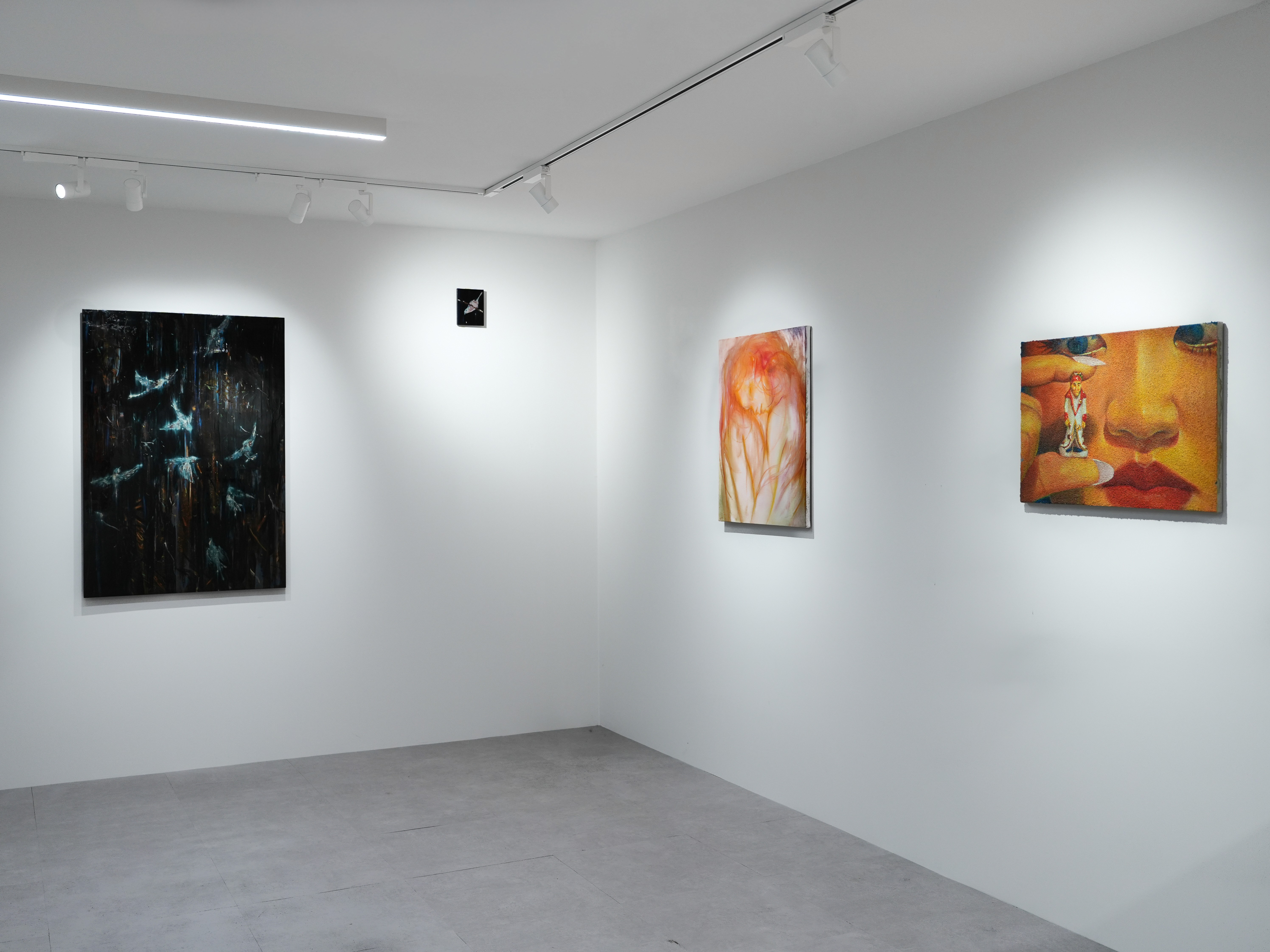
Group show
Whiteout
December 20, 2025 - February 1, 2026
VACANT ROOM は、沖田愛有美、坂本那々莉、髙野詩音によるグループ展「Whiteout」を開催いたします。
Whiteout とは、入射光と反射光が等しい強度で拮抗し、散乱した白光が全方向から均質に降り注ぐことで視界のコントラストが失われ、視覚や平衡感覚が乱れる光学現象を指します。本来、光は対象を可視化するための基底的な媒体ですが、その強度が閾値を超えると、自らの機能を逸脱し、可視性の前提条件を反転させます。
本展は、その閾値に立ち現れる可視性の諸相を、三者それぞれの実践を通して捉えようとする試みです。
沖田愛有美は、東アジアや東南アジアの漆文化を参照しながら、その物質性と歴史を独自の視点で再解釈しています。漆画の制作工程では塗布、乾固、研磨が繰り返され、画面には幾重もの塗膜が形成されます。そのため、光は表面で即座に反射するのではなく、漆層の奥へと一度沈み込み、再び柔らかく浮かび上がることで、画面それ自体が発光しているかのような視覚効果を生み出します。この効果は、漆が数年かけて色彩を鮮やかにさせる固有の変化とも重なり、ここに光と素材との密接な関係が可視化されます。
また、漆という素材が本来的に植物の樹液であり、作り手の意図を超えて自律的に反応する素材である点にも沖田は注目します。漆の自律性を単なる扱いづらさとしてではなく、人と自然を繋ぐ媒介として捉えることで、制作そのものを自然との「共同制作」として位置付け直しています。こうした視点は、自然・女性・境界・生成といった主題へと展開されます。
坂本那々莉は、「自分自身を主人公とした架空の映画のワンシーン」を絵画として構成する実践を続けています。描かれる人物像は、映画的時間のなかで再編成された自己像であり、現実の身体や単なる肖像としての再現とも異なる、光と色彩によって変容する映像的自己として立ち上がります。
その光の扱いは、テクニカラー映画を想起させる飽和度の高い発色や方向性の強さが特徴的で、身体の輪郭や肌理をトレースするのではなく、光源の変化や影の伸び縮みがわずかにずれた時間を伴って像に介入することで、人物像は光の遅延や揺らぎとともに複数の時間の相を重ね持ち、フィクションとしての自己が照射された“場面”として立ち現れます。
また、絵具の層に物質的存在感を付与しながら、同時にスクリーン上のイメージのような非物質的な揺らぎをも併存させています。
本展において坂本の作品は、絵画が光と色彩の操作を通じてどのように映像性を獲得しうるのかを示し、平面絵画の内部に潜む“映像的時間”の可能性を照らし出します。
髙野詩音は、ポートレートを主題とする油彩作品を制作しています。絵画の物質性と自身の身体の物質性、そして光という現象の間に粒子という共通性を見出した髙野は、光を身体像の輪郭や質感、さらには感情にまで微細な揺らぎを与える媒介として捉えなおしています。
局所的な強照度や深い半影といった光の分布は、空間と身体との境界を溶解させ、ときに身体の表面を強調し、あるいは輪郭を消し込むことで、内部の情動を絵具層を通じて可視化します。その結果、人物像は実在の身体の再現にとどまらず、複数の位相を帯びて立ち上がります。
そこには、アイデンティティの揺らぎや、実存と虚構のあわいに生じる不確かさが、光の介入を通してゆるやかに示されています。
三者の実践は、光が素材の層や時間的構造、さらには身体像の輪郭に触れることで生じる微細な変化を、それぞれ独自の技法と造形的アプローチによって表現しています。ここで扱われる光は、単に対象を照らす外在的条件ではなく、画面や身体像の基底へと入り込み、その形成過程を内側から変調させる働きを担います。
こうした光の介入によって生じる「知覚条件の変状」への鋭敏なまなざしが、本展の基調をなしています。
VACANT ROOM is pleased to present “Whiteout,” a group exhibition featuring works by Ayumi Okita, Nanary Sakamoto, and Shion Takano.
Whiteout refers to an optical phenomenon in which incident light and reflected light confront each other with equal intensity, causing diffused white light to fall uniformly from all directions. As a result, visual contrast collapses and both sight and equilibrium become destabilized.
Light ordinarily functions as a fundamental medium that renders objects visible; however, once its intensity exceeds a certain threshold, it deviates from its own function and reverses the very conditions that support visibility.
This exhibition explores the various modalities of visibility that emerge at that threshold through the distinct practices of the three participating artists.
Ayumi Okita reinterprets the materiality and history of lacquer through references to the multilayered lacquer cultures of East and Southeast Asia. In her process, repeated cycles of application, curing, and polishing accumulate numerous layers of lacquer. Light does not immediately reflect off the surface; instead, it sinks once into the depths of the layers and rises softly again, producing a visual effect as though the surface itself were emitting light. This phenomenon resonates with the material’s distinctive chromatic shifts that unfold over several years, making visible the intimate relationship between light and material.
Okita is also attentive to the autonomy of lacquer, a medium derived from plant resin that responds independently of the maker’s intentions. By understanding this autonomy not as resistance but as a mediator between human and nature, she positions the act of painting as a form of “co-production” with natural processes—a perspective that unfolds into themes such as nature, femininity, boundaries, and becoming.
Nanary Sakamoto constructs paintings as “imaginary film stills” in which she casts herself as the protagonist. The depicted figures emerge as cinematic selves—reconfigured within the temporality of film—distinct from real bodies and from portraiture as mere representation.
Her handling of light is marked by the saturated tones and strong directional sources reminiscent of Technicolor film. Variations in the light source and the stretching or shortening of shadows intervene in the image with a subtly displaced temporality, allowing the figure to hold multiple temporal layers at once. Through these slight delays and fluctuations of light, the fictional self appears as a “scene” illuminated within the painting.
Her work simultaneously sustains the material presence of painted layers and the non-material tremors of a screen-like image. In this exhibition, Sakamoto’s practice reveals how painting can acquire an element of cinematicity through the manipulation of light and color, illuminating the potential of “cinematic time” latent within the pictorial plane.
Shion Takano creates oil paintings centered on portraiture. Identifying a shared particulate quality among painting’s materiality, her own bodily materiality, and the phenomenon of light, she reconceives light as a mediator that imparts subtle fluctuations not only to the contour and texture of the body but also to emotional states.
Localised intensities of light and deep penumbrae dissolve the boundary between body and space—at times emphasizing the body’s surface, at other times erasing its contour entirely. Through these shifts, internal emotions are visualized as they permeate the layers of paint, and the figure emerges in multiple phases that exceed the mere reproduction of an actual body.
In these works, the instability between identity and its image—between the real and the fictive—is gently revealed through light’s intervention.
Across these three practices, light engages with the stratified materiality, temporal structures, and bodily contours of the image, giving rise to subtle transformations articulated through each artist’s distinctive methods and formal approaches. Here, light is no longer an external condition that simply illuminates objects; rather, it enters the very foundations of the pictorial and bodily image, altering their formative processes from within.
Such attentiveness to the “shifts in the conditions of perception” produced by the intervention of light forms the conceptual core of this exhibition.
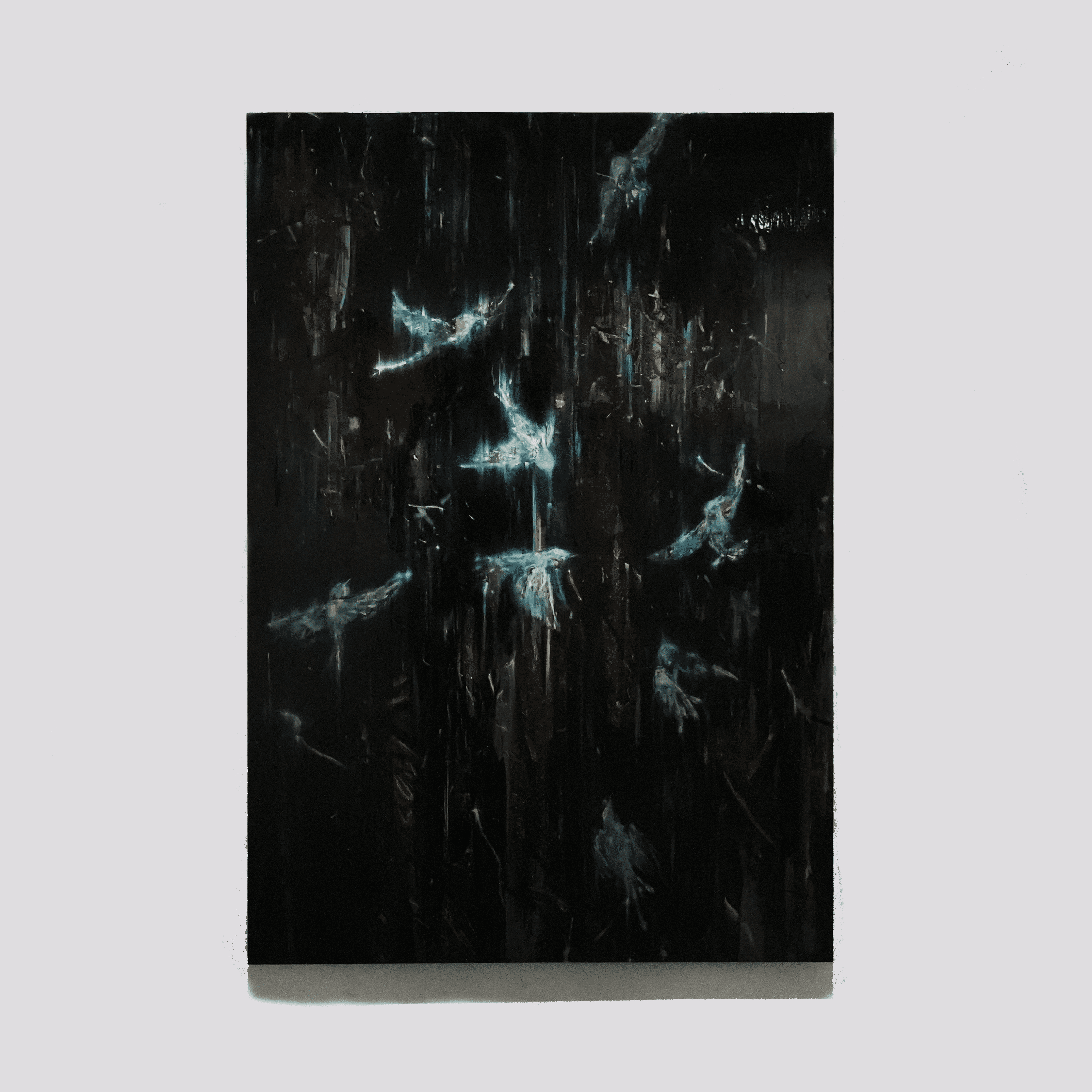
Ayumi Okita
地下の空、肥沃の道
2024
wood panel,linen mesh, urushi lacquer
116.7×80.5cm
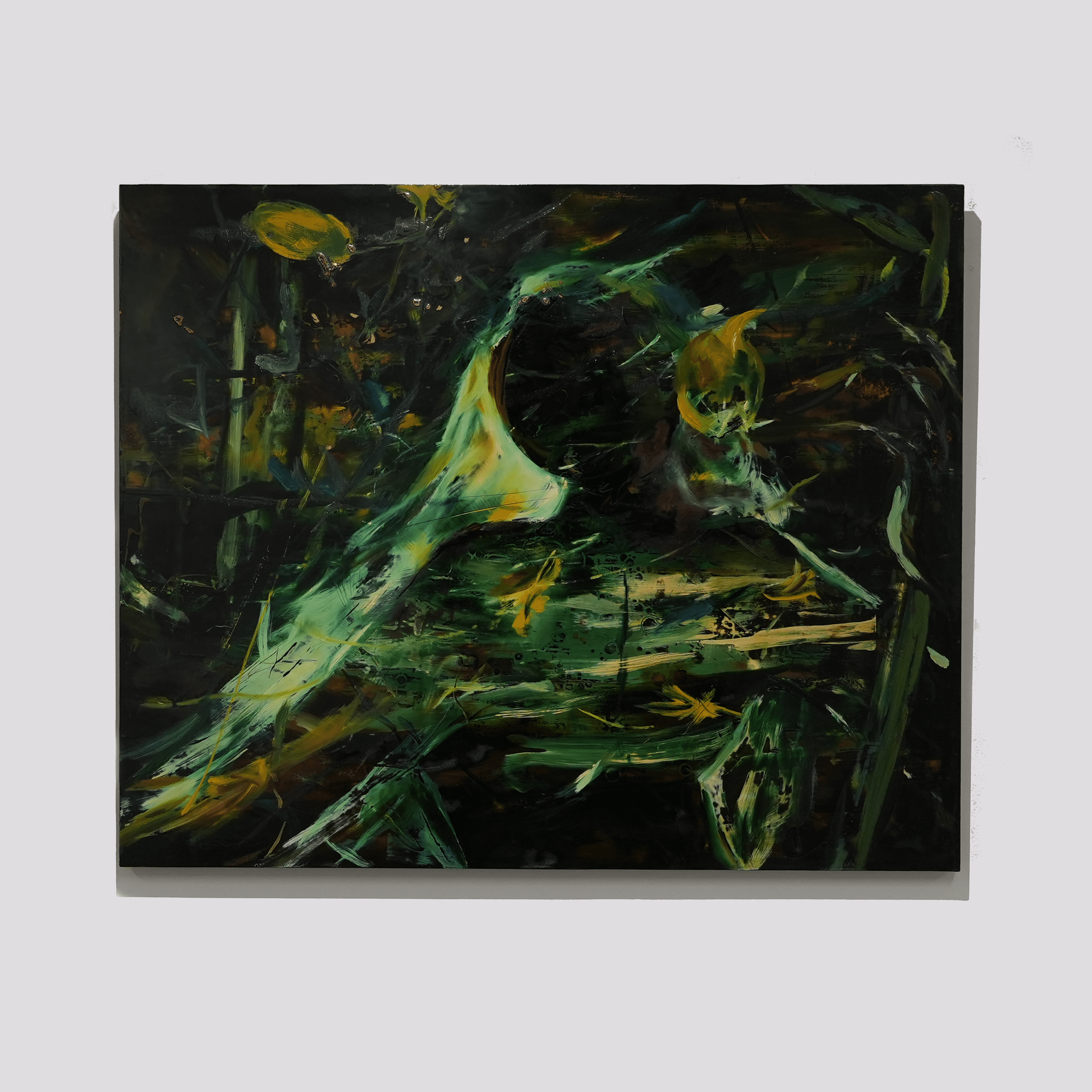
Ayumi Okita
透風の導き
2025
wood panel,linen mesh, urushi lacquer,
53.0×65.3cm
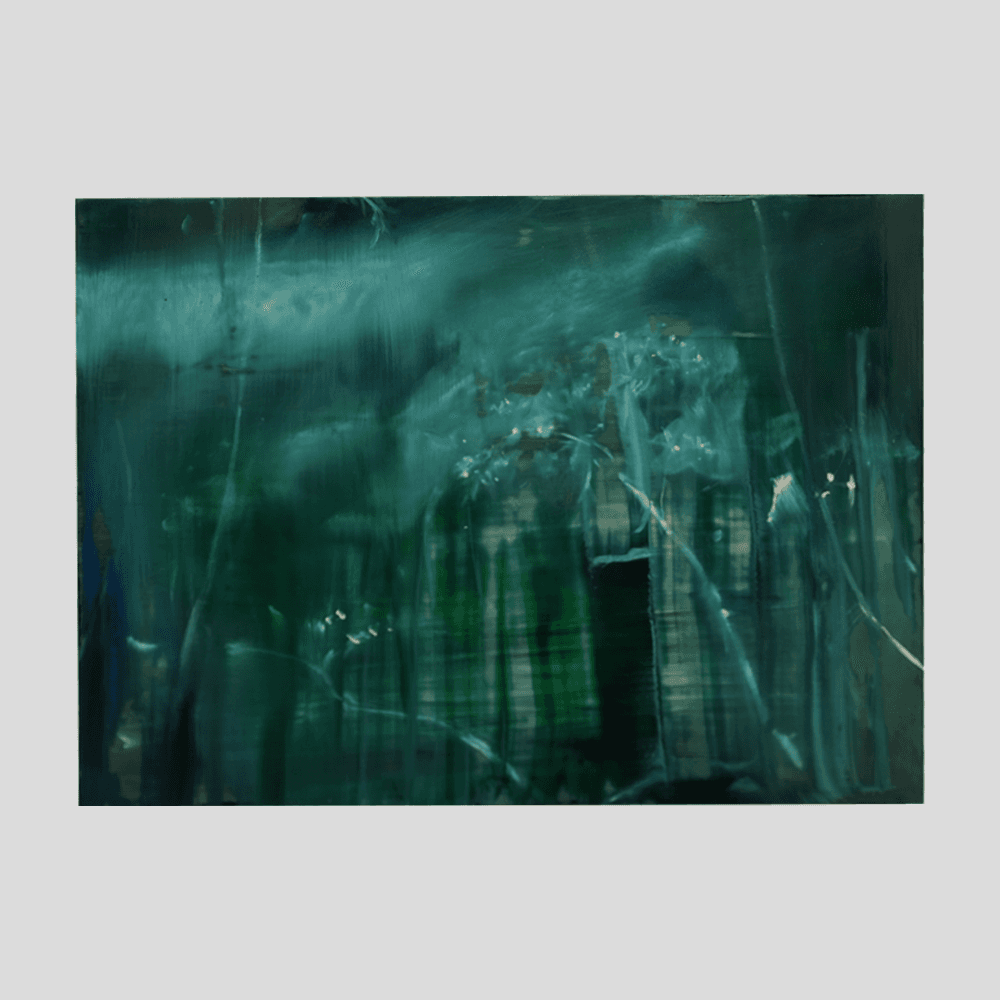
Ayumi Okita
霧水露
2025
wood panel,linen mesh, urushi
19.0×24.0cm

Nanary Sakamoto
"胸や太ももがあっても、
女だって誰でも殺せる"
2024
Oil and acrylic on canvas
91.0×116.7cm

Nanary Sakamoto
"私は有毒"
2025
Oil and acrylic on canvas
27.3×27.3cm

Nanary Sakamoto
"綺麗な花には棘がある"
2026
Oil and acrylic on canvas
19.0×33.3cm

Shion Takano
signal
2025
Oil on panel
30.0×30.0cm

Shion Takano
in white
2025
Oil on panel
65.2×53.0cm

Shion Takano
muse
2026
Oil on canvas
91.0×116.7cm
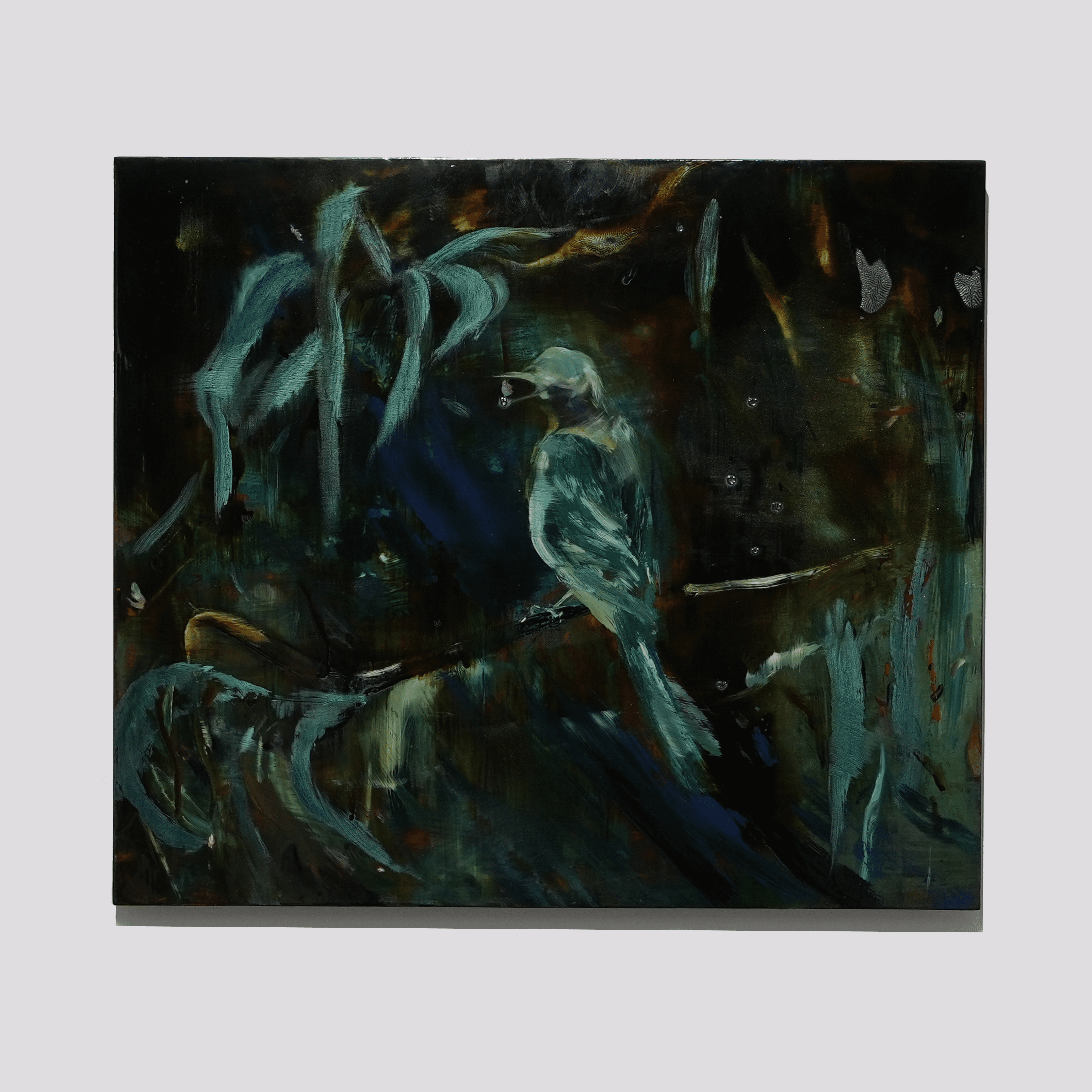
Ayumi Okita
種を咥えた鳥
2024
wood panel,linen mesh, urushi lacquer,
30.7×35.8cm

Ayumi Okita
遠ざかる風を握りしめて
2025
wood panel,linen mesh, urushi lacquer,
28.6×23.2cm
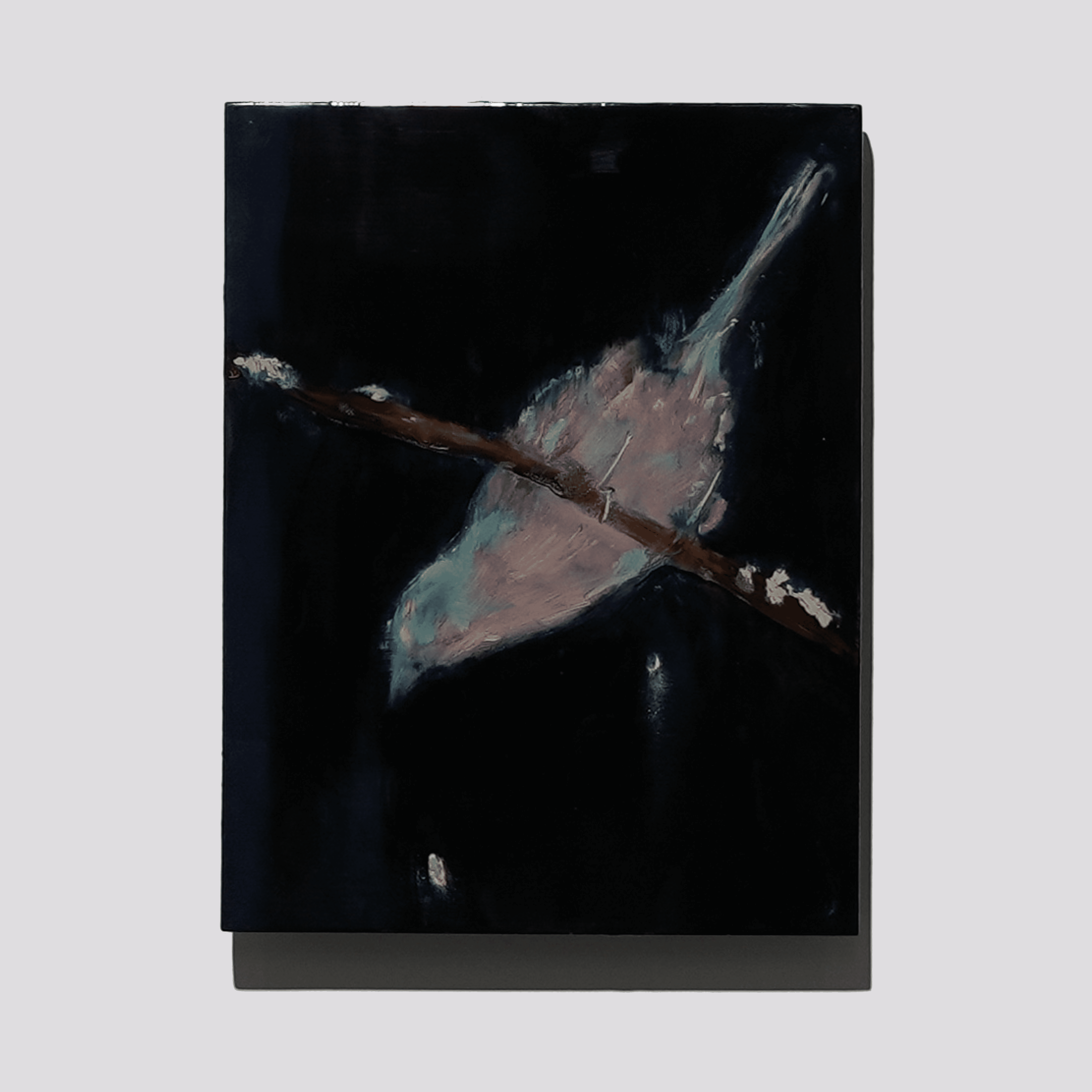
Ayumi Okita
凍気を纏う
2025
wood panel,linen mesh, urushi lacquer,
16.7×12.8cm

Nanary Sakamoto
"誰もが持っているものも、
誰も持っていないものも、
全部欲しい"
2025
Oil and acrylic on canvas
45.5×65.2cm

Nanary Sakamoto
"傷つけてごめんなさい。
実はあの時、機嫌が悪かったの"
2026
Oil and acrylic on canvas
60.6×91.0cm

Shion Takano
Red planet
2025
Oil on canvas
72.7×60.6cm

Shion Takano
radiance
2025
Oil on panel
27.3×22.0cm

Shion Takano
portrait
2024-2026
Oil on canvas
91.0×72.7cm
Works
View Checklist
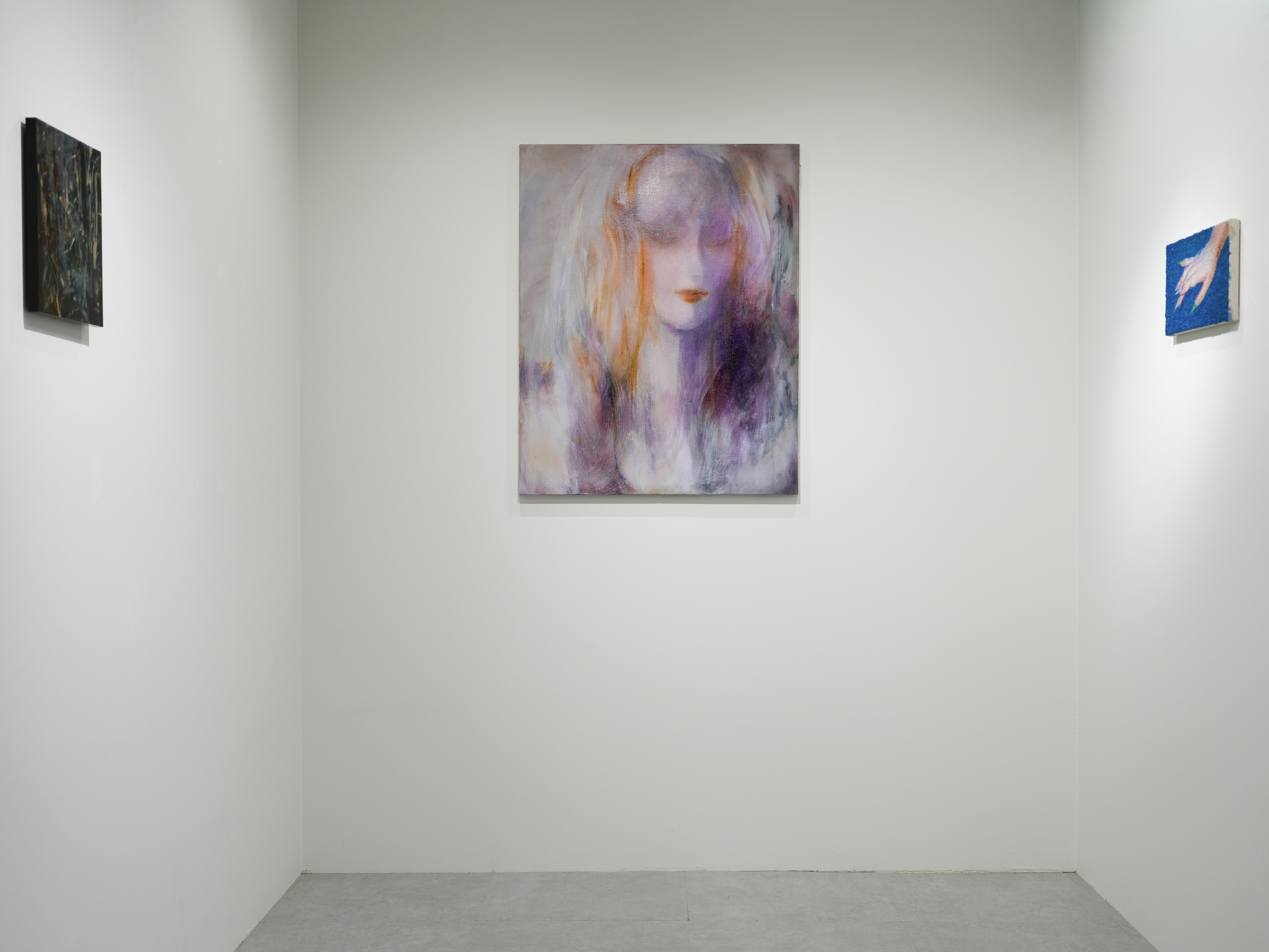
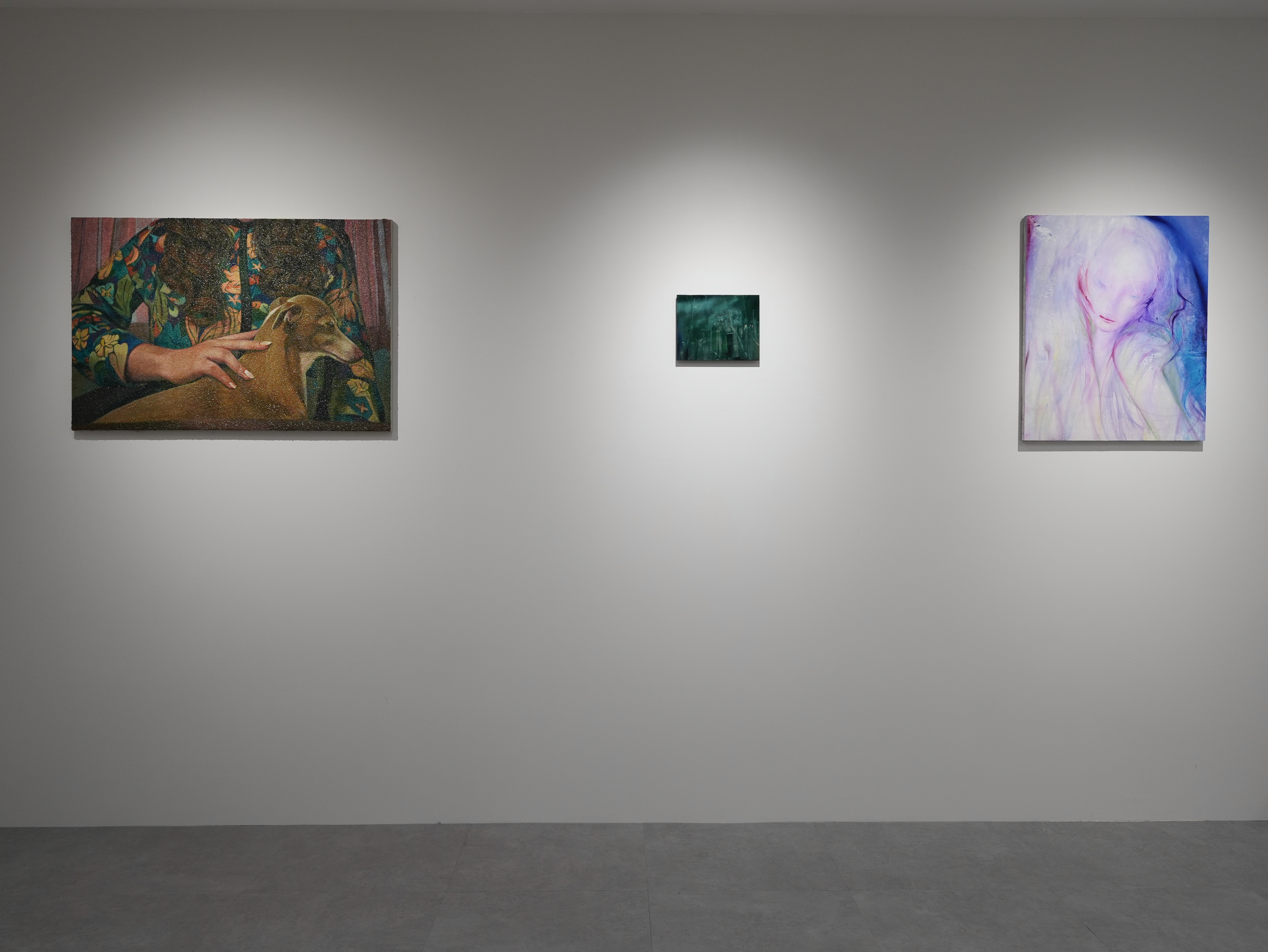
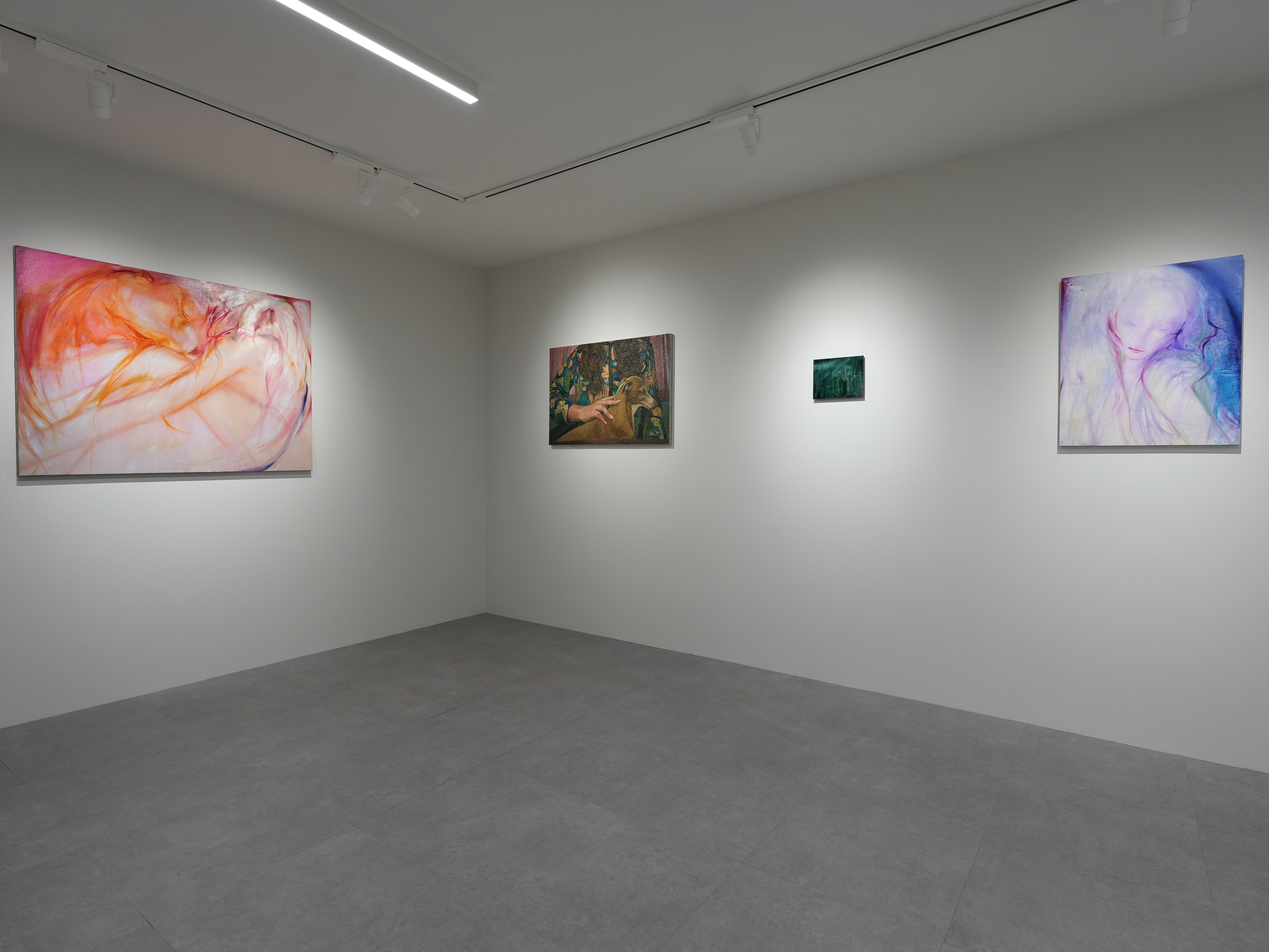
Installation View
開催概要|Exhibition Details
Exhibition Title:Whiteout
Artist:沖田 愛有美|Ayumi Okita 坂本 那々莉|Nanary Sakamoto 高野 詩音|Shion Takano
会期|Dates:2025.12.20(Sat)-2026.2.1(Sun)
Open:Thu-Sun 13:00-19:00
Close:Mon,Tue,Wed,public holidays
*Tuesdays, Wednesdays, and public holidays are open for private viewings by appointment only.
会場|Venue:VACANT ROOM
東京都渋谷区渋谷4-3ー6 B1F
B1F 4-3-6 Shibuya Shibuya-ku Tokyo
Email:info@vacant-room.com
Group show
Whiteout
Whiteout
December 20, 2025 - February 1, 2026
December 20, 2025 - February 1, 2026
VACANT ROOM は、沖田愛有美、坂本那々莉、髙野詩音によるグループ展「Whiteout」を開催いたします。
Whiteout とは、入射光と反射光が等しい強度で拮抗し、散乱した白光が全方向から均質に降り注ぐことで視界のコントラストが失われ、視覚や平衡感覚が乱れる光学現象を指します。本来、光は対象を可視化するための基底的な媒体ですが、その強度が閾値を超えると、自らの機能を逸脱し、可視性の前提条件を反転させます。
本展は、その閾値に立ち現れる可視性の諸相を、三者それぞれの実践を通して捉えようとする試みです。
沖田愛有美は、東アジアや東南アジアの漆文化を参照しながら、その物質性と歴史を独自の視点で再解釈しています。漆画の制作工程では塗布、乾固、研磨が繰り返され、画面には幾重もの塗膜が形成されます。そのため、光は表面で即座に反射するのではなく、漆層の奥へと一度沈み込み、再び柔らかく浮かび上がることで、画面それ自体が発光しているかのような視覚効果を生み出します。この効果は、漆が数年かけて色彩を鮮やかにさせる固有の変化とも重なり、ここに光と素材との密接な関係が可視化されます。
また、漆という素材が本来的に植物の樹液であり、作り手の意図を超えて自律的に反応する素材である点にも沖田は注目します。漆の自律性を単なる扱いづらさとしてではなく、人と自然を繋ぐ媒介として捉えることで、制作そのものを自然との「共同制作」として位置付け直しています。こうした視点は、自然・女性・境界・生成といった主題へと展開されます。
坂本那々莉は、「自分自身を主人公とした架空の映画のワンシーン」を絵画として構成する実践を続けています。描かれる人物像は、映画的時間のなかで再編成された自己像であり、現実の身体や単なる肖像としての再現とも異なる、光と色彩によって変容する映像的自己として立ち上がります。
その光の扱いは、テクニカラー映画を想起させる飽和度の高い発色や方向性の強さが特徴的で、身体の輪郭や肌理をトレースするのではなく、光源の変化や影の伸び縮みがわずかにずれた時間を伴って像に介入することで、人物像は光の遅延や揺らぎとともに複数の時間の相を重ね持ち、フィクションとしての自己が照射された“場面”として立ち現れます。
また、絵具の層に物質的存在感を付与しながら、同時にスクリーン上のイメージのような非物質的な揺らぎをも併存させています。
本展において坂本の作品は、絵画が光と色彩の操作を通じてどのように映像性を獲得しうるのかを示し、平面絵画の内部に潜む“映像的時間”の可能性を照らし出します。
髙野詩音は、ポートレートを主題とする油彩作品を制作しています。絵画の物質性と自身の身体の物質性、そして光という現象の間に粒子という共通性を見出した髙野は、光を身体像の輪郭や質感、さらには感情にまで微細な揺らぎを与える媒介として捉えなおしています。
局所的な強照度や深い半影といった光の分布は、空間と身体との境界を溶解させ、ときに身体の表面を強調し、あるいは輪郭を消し込むことで、内部の情動を絵具層を通じて可視化します。その結果、人物像は実在の身体の再現にとどまらず、複数の位相を帯びて立ち上がります。
そこには、アイデンティティの揺らぎや、実存と虚構のあわいに生じる不確かさが、光の介入を通してゆるやかに示されています。
三者の実践は、光が素材の層や時間的構造、さらには身体像の輪郭に触れることで生じる微細な変化を、それぞれ独自の技法と造形的アプローチによって表現しています。ここで扱われる光は、単に対象を照らす外在的条件ではなく、画面や身体像の基底へと入り込み、その形成過程を内側から変調させる働きを担います。
こうした光の介入によって生じる「知覚条件の変状」への鋭敏なまなざしが、本展の基調をなしています。
VACANT ROOM is pleased to present “Whiteout,” a group exhibition featuring works by Ayumi Okita, Nanary Sakamoto, and Shion Takano.
Whiteout refers to an optical phenomenon in which incident light and reflected light confront each other with equal intensity, causing diffused white light to fall uniformly from all directions. As a result, visual contrast collapses and both sight and equilibrium become destabilized.
Light ordinarily functions as a fundamental medium that renders objects visible; however, once its intensity exceeds a certain threshold, it deviates from its own function and reverses the very conditions that support visibility.
This exhibition explores the various modalities of visibility that emerge at that threshold through the distinct practices of the three participating artists.
Ayumi Okita reinterprets the materiality and history of lacquer through references to the multilayered lacquer cultures of East and Southeast Asia. In her process, repeated cycles of application, curing, and polishing accumulate numerous layers of lacquer. Light does not immediately reflect off the surface; instead, it sinks once into the depths of the layers and rises softly again, producing a visual effect as though the surface itself were emitting light. This phenomenon resonates with the material’s distinctive chromatic shifts that unfold over several years, making visible the intimate relationship between light and material.
Okita is also attentive to the autonomy of lacquer, a medium derived from plant resin that responds independently of the maker’s intentions. By understanding this autonomy not as resistance but as a mediator between human and nature, she positions the act of painting as a form of “co-production” with natural processes—a perspective that unfolds into themes such as nature, femininity, boundaries, and becoming.
Nanary Sakamoto constructs paintings as “imaginary film stills” in which she casts herself as the protagonist. The depicted figures emerge as cinematic selves—reconfigured within the temporality of film—distinct from real bodies and from portraiture as mere representation.
Her handling of light is marked by the saturated tones and strong directional sources reminiscent of Technicolor film. Variations in the light source and the stretching or shortening of shadows intervene in the image with a subtly displaced temporality, allowing the figure to hold multiple temporal layers at once. Through these slight delays and fluctuations of light, the fictional self appears as a “scene” illuminated within the painting.
Her work simultaneously sustains the material presence of painted layers and the non-material tremors of a screen-like image. In this exhibition, Sakamoto’s practice reveals how painting can acquire an element of cinematicity through the manipulation of light and color, illuminating the potential of “cinematic time” latent within the pictorial plane.
Shion Takano creates oil paintings centered on portraiture. Identifying a shared particulate quality among painting’s materiality, her own bodily materiality, and the phenomenon of light, she reconceives light as a mediator that imparts subtle fluctuations not only to the contour and texture of the body but also to emotional states.
Localised intensities of light and deep penumbrae dissolve the boundary between body and space—at times emphasizing the body’s surface, at other times erasing its contour entirely. Through these shifts, internal emotions are visualized as they permeate the layers of paint, and the figure emerges in multiple phases that exceed the mere reproduction of an actual body.
In these works, the instability between identity and its image—between the real and the fictive—is gently revealed through light’s intervention.
Across these three practices, light engages with the stratified materiality, temporal structures, and bodily contours of the image, giving rise to subtle transformations articulated through each artist’s distinctive methods and formal approaches. Here, light is no longer an external condition that simply illuminates objects; rather, it enters the very foundations of the pictorial and bodily image, altering their formative processes from within.
Such attentiveness to the “shifts in the conditions of perception” produced by the intervention of light forms the conceptual core of this exhibition.
Works
Works
Ayumi Okita
地下の空、肥沃の道
2024
wood panel,linen mesh, urushi lacquer
116.7×80.5cm
Ayumi Okita
透風の導き
2025
wood panel,linen mesh, urushi lacquer,
53.0×65.3cm
Ayumi Okita
霧水露
2025
wood panel,linen mesh, urushi
19.0×24.0cm
Nanary Sakamoto
"胸や太ももがあっても、
女だって誰でも殺せる"
2024
Oil and acrylic on canvas
91.0×116.7cm
Nanary Sakamoto
"私は有毒"
2025
Oil and acrylic on canvas
27.3×27.3cm
Nanary Sakamoto
"綺麗な花には棘がある"
2026
Oil and acrylic on canvas
19.0×33.3cm
Shion Takano
signal
2025
Oil on panel
30.0×30.0cm
Shion Takano
in white
2025
Oil on panel
65.2×53.0cm
Shion Takano
muse
2026
Oil on canvas
91.0×116.7cm
Ayumi Okita
種を咥えた鳥
2024
wood panel,linen mesh, urushi lacquer,
30.7×35.8cm
Ayumi Okita
遠ざかる風を握りしめて
2025
wood panel,linen mesh, urushi lacquer,
28.6×23.2cm
Ayumi Okita
凍気を纏う
2025
wood panel,linen mesh, urushi lacquer,
16.7×12.8cm
Nanary Sakamoto
"誰もが持っているものも、
誰も持っていないものも、
全部欲しい"
2025
Oil and acrylic on canvas
45.5×65.2cm
Nanary Sakamoto
"傷つけてごめんなさい。
実はあの時、機嫌が悪かったの"
2026
Oil and acrylic on canvas
60.6×91.0cm
Shion Takano
Red planet
2025
Oil on canvas
72.7×60.6cm
Shion Takano
radiance
2025
Oil on panel
27.3×22.0cm
Shion Takano
portrait
2024-2026
Oil on canvas
91.0×72.7cm
Installation View
Installation View
開催概要|Exhibition Details
Exhibition Title:Whiteout
Artist:沖田 愛有美|Ayumi Okita 坂本 那々莉|Nanary Sakamoto 高野 詩音|Shion Takano
会期|Dates:2025.12.20(Sat)-2026.2.1(Sun)
Open:Thu-Sun 13:00-19:00
Close:Mon,Tue,Wed,public holidays
*Tuesdays, Wednesdays, and public holidays are open for private viewings by appointment only.
会場|Venue:VACANT ROOM
東京都渋谷区渋谷4-3ー6 B1F
B1F 4-3-6 Shibuya Shibuya-ku Tokyo
Email:info@vacant-room.com
開催概要|Exhibition Details
Exhibition Title:Whiteout
Artist:沖田 愛有美|Ayumi Okita 坂本 那々莉|Nanary Sakamoto 高野 詩音|Shion Takano
会期|Dates:2025.12.20(Sat)-2026.2.1(Sun)
Open:Thu-Sun 13:00-19:00
Close:Mon,Tue,Wed,public holidays
*Tuesdays, Wednesdays, and public holidays are open for private viewings by appointment only.
会場|Venue:VACANT ROOM
東京都渋谷区渋谷4-3ー6 B1F
B1F 4-3-6 Shibuya Shibuya-ku Tokyo
Email:info@vacant-room.com